
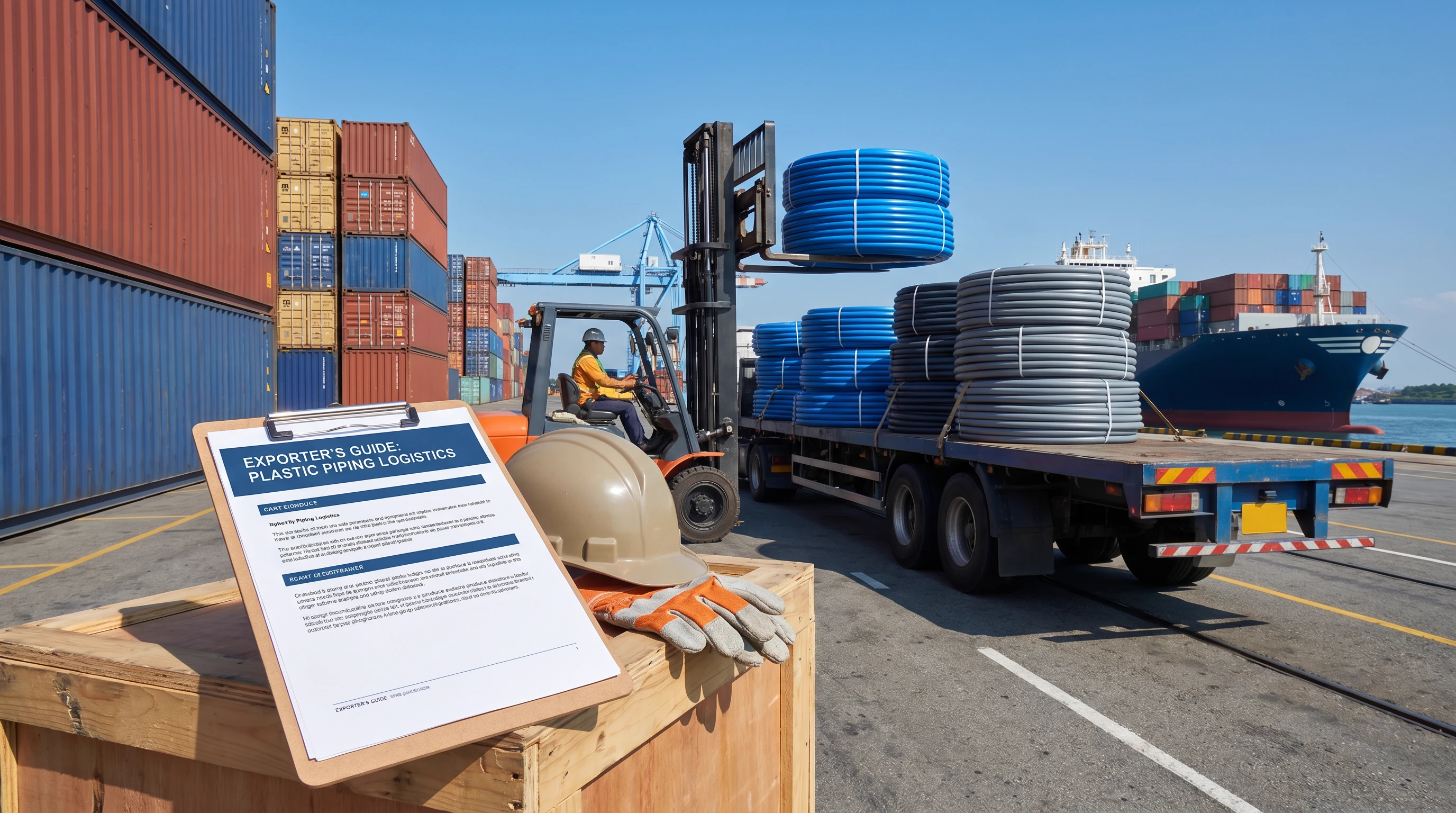
Expanding your piping business into international markets like Africa and the Middle East is a lucrative move, but it comes with a unique set of logistical challenges. From optimising container space to ensuring technical compliance with regional standards, successful exporting requires a precision-driven approach.
This guide outlines the essential pillars of shipping and logistics for PVC, HDPE, and MDPE piping materials to ensure your products arrive on time, on budget, and in perfect condition.
1. Container Optimisation: The “Nesting” Strategy
Shipping “air” is the most common mistake in piping logistics. Since pipes are hollow, shipping them as individual units is expensive.
- Telescopic Loading (Nesting): To maximise 20ft or 40ft HC containers, we utilise nesting. By placing smaller diameter pipes (e.g., 63mm) inside larger ones (e.g., 200mm), you can effectively double your shipment volume without increasing container costs.
- Bundle Management: Smaller pipes should be hexagonal-bundled with polypropylene straps to prevent shifting during transit.
2. Protecting the Product: Beyond the Warehouse
Plastic pipes—especially uPVC and HDPE—are durable but can be damaged by improper handling or extreme environments.
- Bell-End Protection: The socket or bell-end of the pipe is the most vulnerable point. We use protective end-caps to prevent cracking during crane loading and unloading.
- UV Protection for Transit: For shipments to high-heat regions in the Middle East, pipes should be stored in shaded areas or covered with UV-resistant tarps if they are not being shipped in closed containers.
- Avoiding “Point Loading”: During stacking, ensure the bottom layer is supported by flat wooden dunnage to prevent the pipes from deforming under their own weight.
3. Navigating Regional Standards & Documentation
Every region has its own “gatekeeper” standards.
- Africa: Many African markets require Pre-Export Verification of Conformity (PVoC). Ensuring your pipes carry the ISI mark and are accompanied by a Certificate of Conformity (CoC) is vital for clearing customs in Kenya, Nigeria, and Ghana.
- Middle East: Standards like SASO (Saudi Arabia) or ESMA (UAE) are strict. Your technical data sheets must clearly state the PE grade (PE80/100) and PN ratings to match local infrastructure requirements.
4. Documentation Checklist for Smooth Clearance
To avoid costly “demurrage” (storage fees) at the port, ensure the following documents are 100% accurate:
- Commercial Invoice & Packing List: Detailing the exact meterage, weight, and SDR ratings.
- Bill of Lading (B/L):The “title” to your goods.
- Certificate of Origin: Critical for claiming preferential duty rates under trade agreements.
- Technical Data Sheets: Specifically for MDPE gas pipes or HDPE DWC pipes, where safety compliance is a top priority.
5. Why Partner with an Experienced Exporter?
Logistics in the piping industry isn’t just about moving boxes; it’s about moving infrastructure. A partner who understands Indian Standard (ISI)compliance and has a footprint in global trade ensures that technical errors don’t become financial losses.
Planning an international project?
We specialise in the export of HDPE, PVC, and MDPE pipes to Africa and the Middle East. Contact our export desk today for a customised shipping quote and container load plan.
Contact Export Desk