
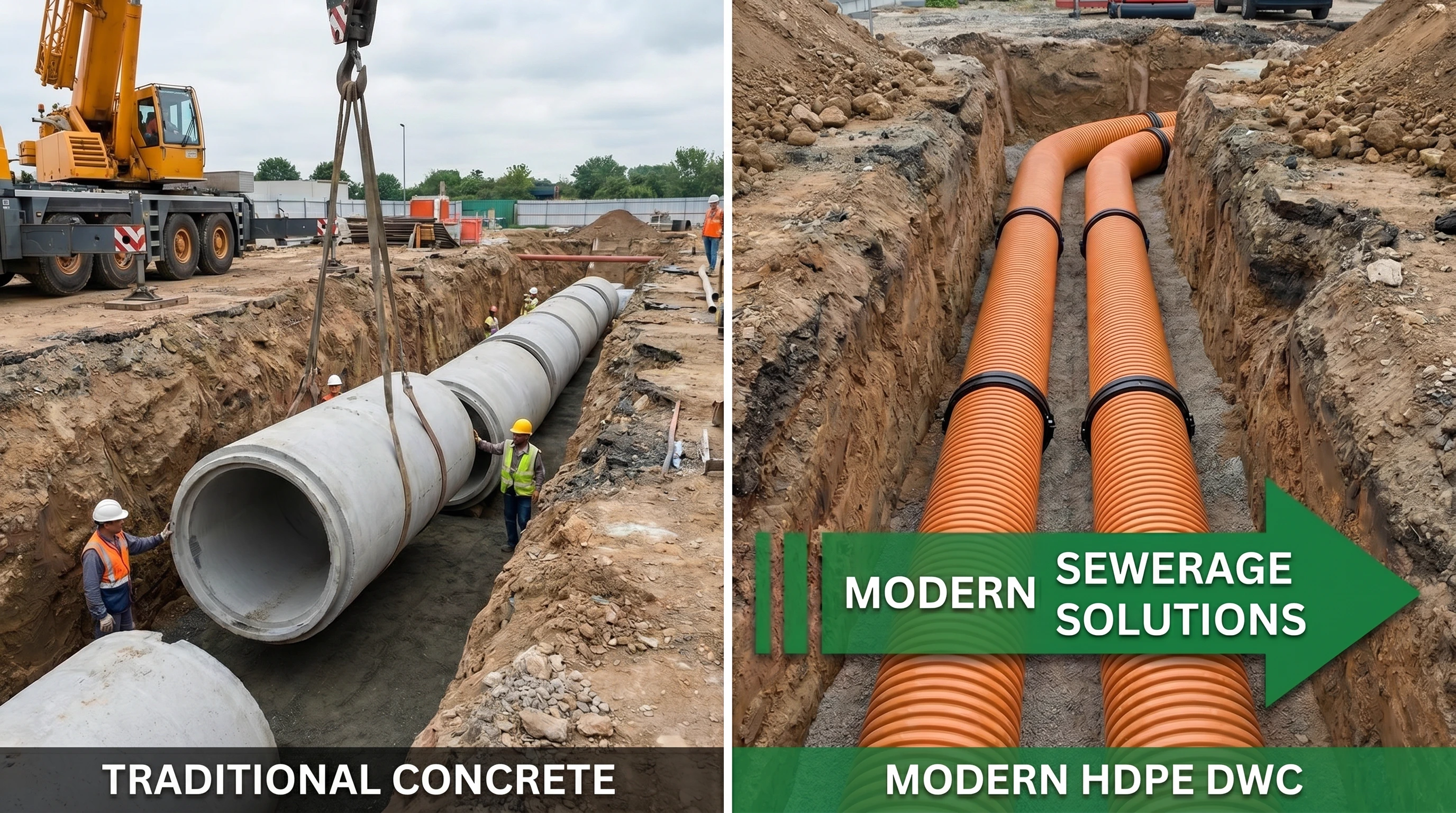
In the world of urban infrastructure, the underground “veins” of our cities—sewerage and drainage systems—are undergoing a silent revolution. For decades, concrete pipes were the default choice, but they are rapidly being phased out in favour of HDPE DWC (High-Density Polyethylene Double Wall Corrugated) pipes.
But why are engineers and municipal contractors making the switch? This article explores the technical and economic advantages that make HDPE DWC the future of sewerage management.
The Anatomy of HDPE DWC Pipes
Unlike traditional single-wall pipes, DWC pipes feature a unique dual-layer construction:
- Outer Corrugated Layer: Provides high ring stiffness and excellent load-bearing capacity to withstand heavy soil and traffic pressure.
- Inner Smooth Layer: Ensures a low friction coefficient, allowing for the rapid, laminar flow of waste and preventing sediment buildup.
Key Reasons for the Shift from Concrete to HDPE DWC
1. Incredible Lifespan and Corrosion Resistance
Concrete pipes are porous and highly susceptible to chemical erosion from sewage gases (like hydrogen sulfide) and soil chemicals. HDPE is chemically inert, offering a service life of over 50 years without the risk of corrosion or scaling.
2. Superior Joint Integrity
One of the biggest failures in concrete systems is joint leakage, which leads to soil contamination and sinkholes. HDPE DWC pipes utilise advanced ring-fit or solvent-weld joints that are 100% leak-proof and flexible enough to withstand minor ground movements.
3. Lightweight Efficiency
Concrete pipes are notoriously heavy, requiring massive cranes and high transport costs. HDPE DWC pipes are significantly lighter, enabling:
- Lower transportation expenses
- Faster installation with smaller crews
- Easier handling in cramped urban environments
4. Cost-Effectiveness (Total Cost of Ownership)
While the upfront material cost may be comparable, the Total Cost of Ownership (TCO) for HDPE is much lower. Reduced labour, faster project completion times, and near-zero maintenance requirements make it the more economical choice for large-scale municipal projects.
Technical Comparison at a Glance
| Feature | Concrete Pipes | HDPE DWC Pipes |
|---|---|---|
| Durability | Prone to cracks and corrosion | Highly resistant to chemicals & impact |
| Flow Efficiency | High friction (rough surface) | Ultra-low friction (smooth bore) |
| Installation | Slow; requires heavy machinery | Rapid; easy handling |
| Maintenance | Frequent desilting / repairs | Self-cleaning; minimal maintenance |
Compliance and Standards
When sourcing HDPE DWC pipes, it is critical to ensure they meet ISI and international standards for load-bearing capacity and material grade. This ensures that the infrastructure can handle the demands of modern urban growth without premature failure.
Conclusion
The transition from concrete to HDPE DWC isn’t just a trend—it’s a technical necessity for building resilient, sustainable cities. By choosing DWC, contractors ensure a leak-proof, long-lasting, and efficient sewerage network.
Looking for high-grade HDPE DWC solutions?
We provide ISI-certified piping for municipal and industrial projects. Contact us today for technical specifications and bulk pricing for your next project.
Contact Us