
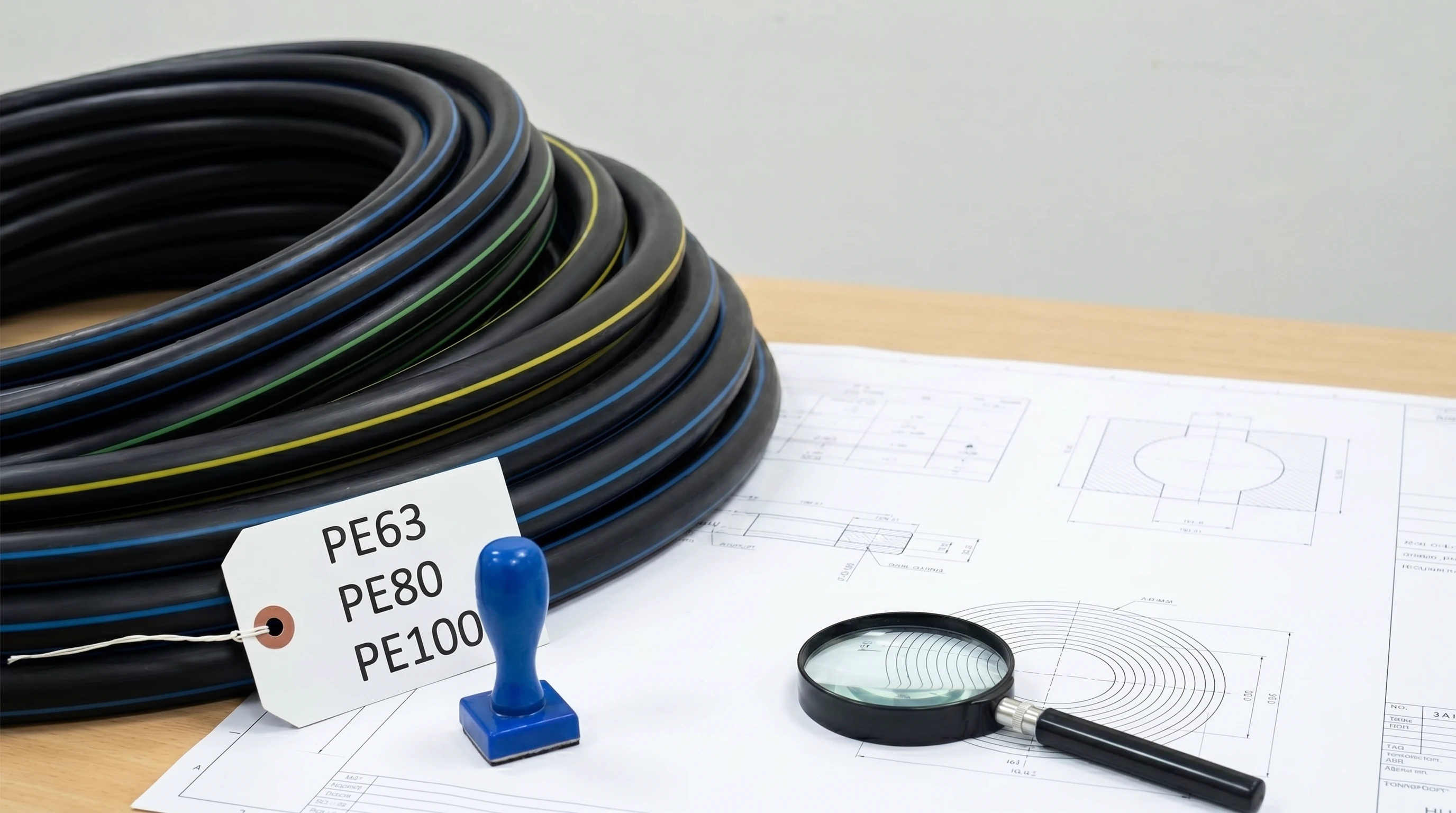
When it comes to building resilient infrastructure—whether for a sprawling agricultural field, a city-wide gas network, or a high-pressure industrial plant—the choice of piping material is paramount. In India, the gold standard for High-Density Polyethylene (HDPE) pipes is IS 4984:2016.
But what do the technical labels like PE63, PE80, and PE100 actually mean for your project? This guide breaks down the ISI standards to help you choose the right pipe with confidence.
1. What are PE Grades? (The Strength Factor)
The “PE” in HDPE stands for Polyethylene, and the number following it represents the Minimum Required Strength (MRS)of the material after 50 years of service at 20°C.
- PE63 (MRS 6.3 MPa): An older grade with lower strength. While it was once common for irrigation and small drinking water connections, it is less frequently used today as stronger materials have become more affordable.
- PE80 (MRS 8.0 MPa): A versatile medium-strength grade. It is a staple for natural gas distribution networks (up to 4 bars) and drinking water pipes (up to 16 bars).
- PE100 (MRS 10.0 MPa):The “Premium” grade. PE100 offers the highest strength, allowing for thinner pipe walls while maintaining the same pressure rating as PE80. This is the go-to for high-demand industrial applications and large-scale water mains.
2. Deciphering Pressure (PN) and Wall Thickness (SDR)
To fully understand the ISI size chart, you must look at how the PE grade interacts with PN and SDR.
Nominal Pressure (PN)
The PN rating indicates the maximum pressure (in bars) the pipe can handle at 20°C.
- Common Ratings: PN4, PN6, PN10, PN16, and up to PN20.
- High Performance: A PE100 pipe can achieve a PN16 rating with a thinner wall than a PE80 pipe, saving on material weight and cost.
Standard Dimension Ratio (SDR)
SDR is the ratio of the pipe’s outer diameter to its wall thickness (SDR = D/s).
- The Inverse Rule: A lower SDR (like SDR 7.4 or 9) means a thicker wall and higher pressure capability.
- Higher SDR: An SDR of 21 or 26 indicates a thinner wall, suitable for low-pressure drainage or gravity-fed systems.
3. Application Guide: Which Pipe Goes Where?
| Application | Recommended Grade | Key Feature |
|---|---|---|
| Agriculture / Irrigation | PE63 / PE80 | Flexible for drip & sprinkler systems |
| Potable Water Supply | PE80 / PE100 | Safe, non-toxic, and leak-proof |
| Gas Distribution | PE80 / PE100 | Crack-resistant; colour-coded yellow or black/yellow |
| Industrial Chemicals | PE100 | High chemical and abrasion resistance |
| Borewell / Casing | PE100 | High tensile strength to handle pump weight |
4. Why Compliance with IS 4984:2016 Matters
Using ISI-marked pipes isn’t just about legality; it’s about safety. IS 4984 requires rigorous testing, including:
- Internal Pressure Creep Rupture Test: Ensures the pipe won't burst under long-term stress.
- Oxidation Induction Time (OIT): Checks the material's thermal stability.
- Melt Flow Rate (MFR): Verifies the quality of the resin used.
- Carbon Black Content: Ensures the pipe is UV resistant and won't degrade in the sun.
Conclusion
Understanding the difference between PE63, PE80, and PE100 is the first step toward a successful piping project. While PE100 offers the best overall performance, PE80 remains a cost-effective choice for many standard applications. Always ensure your supplier provides pipes that adhere strictly to the IS 4984:2016 guidelines to guarantee a service life of 50 years or more.
Ready to choose the right HDPE grade?
We manufacture a full range of ISI-standard HDPE pipes in PE63, PE80, and PE100 grades. Request a Size & Weight Chart today to find the perfect fit for your project.
Request a Chart